
Disclaimer time.
I am not a touring, club, or teaching pro. This is not a tour practice plan. It is the 30 minute simulator routine I’ve developed because I have a normal life and limited patience. I’m just a dude that’s hovering around a 10 handicap after picking the game back up a year ago. I’m looking to lower my scores and handicap without cutting too many corners. I also watch A TON of golf instruction videos, instagram golf brain rot, and youtube golf.
End Disclaimer.
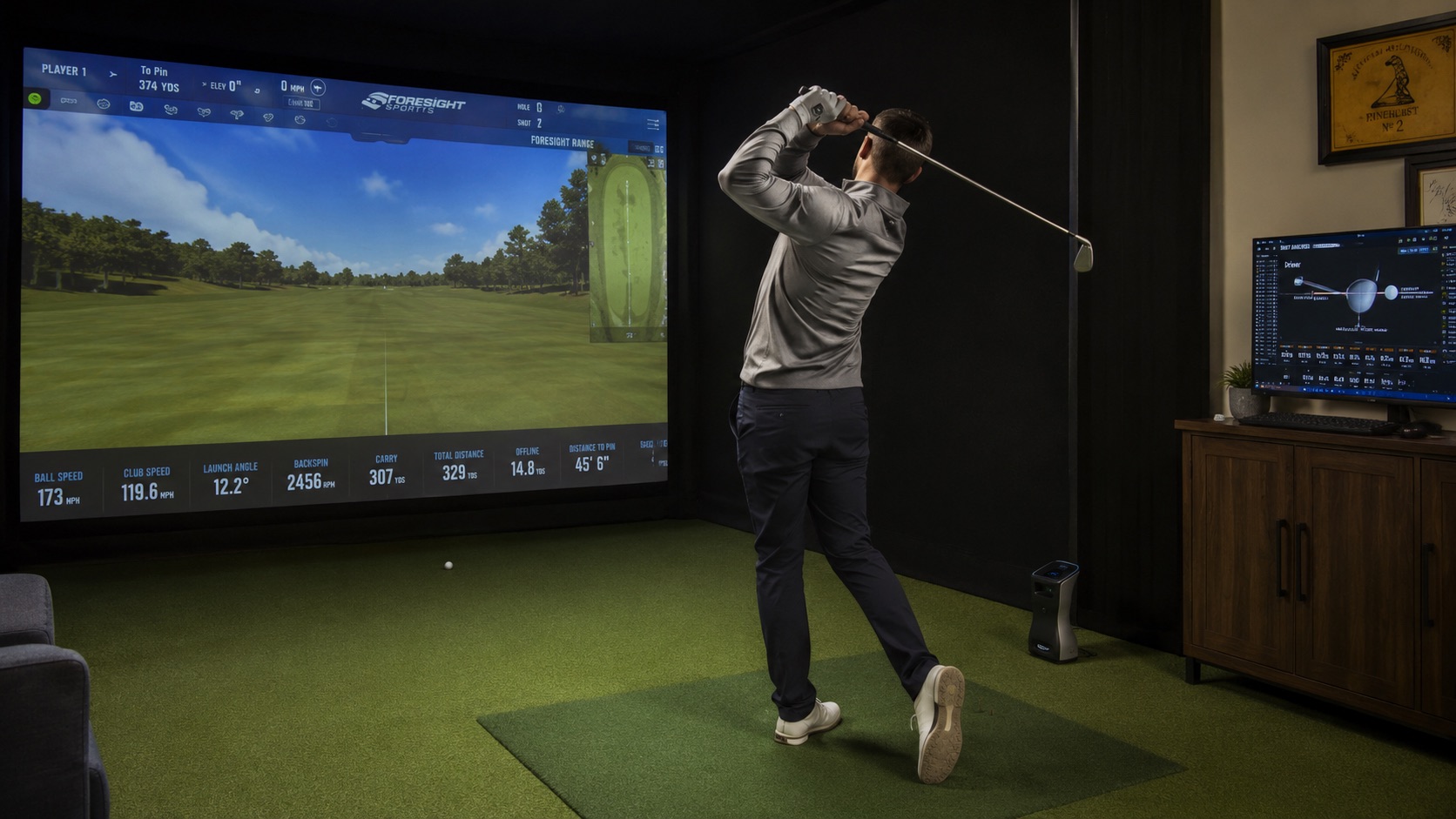
The biggest advantage of a home golf simulator is not that you can hit 300 balls. It is that you can hit 50 or 60 balls with a purpose, then go back inside before the session turns into nonsense.
That is the part I had to learn. More balls is not always better. Sometimes it’s just more evidence that you should have stopped twenty minutes ago.
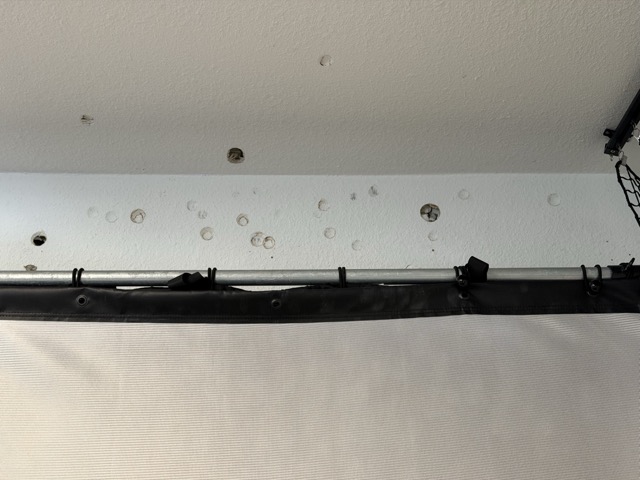
Also, I gotta finish the top section of my simulator. The additional height from hitting wedges means I’m missing my screen and causing a future drywall replacement. Yes, this really is the top of my screen. Oops…
The goal
My 30-minute session is built around one thing: repeatable contact and useful carry distances.
I am not rebuilding my swing every night. I am not chasing perfect launch numbers. I am trying to learn what my stock shots actually do and make the bad shots less dramatic…or at least more predictable.
The Rapsodo MLM2PRO is great for this because I trust it most with irons and wedges. Driver data is less reliable, so I don’t build the session around driver unless I’m specifically working on dispersion or setup.
The setup
- Rapsodo MLM2PRO launch monitor
- Motivo Fairway One mat
- Impact screen/projector setup
- The Ping G440 irons I actually play
- Enough Titleist prov1 RPT balls to avoid breaking rhythm
The mat matters here. If your hitting surface hurts after ten fat shots, you will not practice honestly. You will start protecting your hands and elbows, and that changes the swing.
Minute 0-5: boring warm-up
I start with wedges and short irons. Half swings first. Then three-quarter swings. Then a few normal swings.
I am not looking for perfect numbers yet. I am checking whether my body is awake and whether the launch monitor is reading shots cleanly. If the first five balls are ugly, that’s fine. The first five balls are allowed to be ugly. They are basically coffee.
I’m also trying to make sure I’m getting the club shallow and into the slot, and rotating my body through contact. Like most amateurs, I definitely struggle with coming over the top without realizing it. So, I have to get this muscle memory ingrained early in the session.
Typical warm-up:
- 5 easy wedge swings
- 5 pitching wedge or 9-iron swings
- 5 stock 7-iron swings
The only rule is no hero swings. If I start the session trying to prove something, the session usually gets dumb fast.
Minute 5-15: one club, one number
This is the most useful block.
I pick one club and one carry distance. Usually it is a mid-iron or wedge. Then I hit enough balls to see whether the number is real.
Example: 7-iron carry. If I think my stock 7-iron carries around 175, I want to see a cluster around that number. Not one perfect shot. A cluster. Golfers lie to themselves with single best shots all the time. Launch monitors make that harder, which is rude but helpful.
Success looks like: most decent swings finish within a small window of the target carry. For me, that might be roughly five yards either way depending on the club and what I am working on.
If the numbers are scattered everywhere, I do not immediately blame the device. I check contact first. Then setup. Then tempo. Usually the answer is less mysterious than I want it to be.
Minute 15-23: wedge distance control
Wedges are where a home simulator earns its keep.
I like working on partial distances because they show up constantly on the course. Full swings are easier. The awkward 70- to 100-yard shot is where I can waste strokes quickly on the course.
A normal wedge block might look like this:
- 5 balls to one comfortable full wedge number
- 5 balls to a three-quarter number
- 5 balls alternating between the two
The alternating part matters. Hitting the same shot ten times in a row can make you feel better than you are. Switching targets exposes whether you actually own the motion.
Minute 23-28: random practice
This is where I try to make it more like golf.
I pick different clubs and different targets. One 8-iron. One wedge. One 6-iron. Back to wedge. Maybe a driver if I want to see start line and general shape, but I do not get married to the spin number.
The point is to stop raking balls and pretending that groove practice is the same as playing. On the course, nobody lets you hit seven 7-irons until one behaves.
Minute 28-30: end on something normal
I try to end with a club I trust.
That might sound soft, but ending matters. If I finish with five angry driver swings, I walk away annoyed and remember the session as worse than it was. If I finish with a smooth wedge or 7-iron, I leave with a feel I can actually use next time.
The last swing does not need to be perfect. It just needs to be normal.
What I track
I track less than the launch monitor offers.
- Carry distance
- Start direction
- Shot shape
- Obvious contact pattern
- Whether the session had a repeatable feel
I do not stare at every number like it contains the meaning of life. Too much data can turn a 30-minute practice session into a spreadsheet with golf clubs.
What I ignore
I mostly ignore driver spin on the MLM2PRO. I also ignore any single weird reading unless it repeats. One odd number is noise. A pattern is information.
That distinction saves a lot of frustration.
The mistake I keep making
I still sometimes keep going after the useful work is done.
The session starts well. I get the numbers I wanted. Then I think, since I am already here, I may as well hit a few more. Twenty minutes later I am tired, annoyed, and working on three swing thoughts at once.
That is how good practice turns into ball beating.
Bottom line
A 30-minute simulator session is enough if it has a point.
Warm up. Pick one club and one number. Work wedges. Add a little random practice. Stop before you start chasing ghosts.
The simulator is there to make practice easier to repeat. That is the win. Not perfect data. Not marathon sessions. Just more useful swings, more often.